
1. Conditions Hero: Stop the Scroll in 10 Seconds
About this section
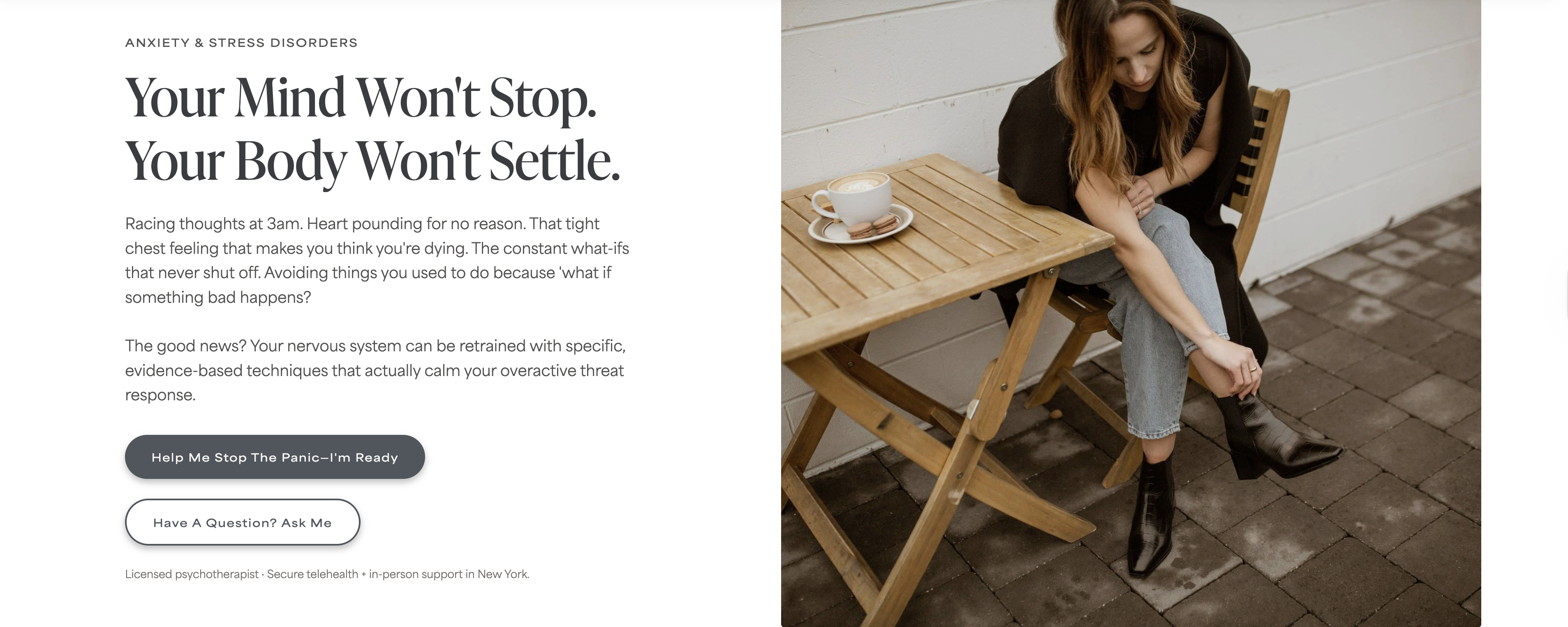
The conversion moment: Someone just landed on your conditions page from Google or your services page. They're asking one question: "Does this person actually get what I'm going through?" You have about 10 seconds before they hit the back button. This isn't about listing credentials or making promises. It's about recognition. When someone reads your hero and thinks "they get it"—that's when hesitation converts to booking.
The data: Conditions pages with generic therapy language ("I can help with anxiety") convert 11-14% lower than pages that name the actual lived experience ("Your mind won't stop. Your body won't settle"). Why? Because nobody books therapy for what it promises. They book because they feel understood. That recognition moment—"this person knows exactly what I'm going through"—is what drives conversion.
What you're building: Five elements with specific conversion jobs. Category label (confirms right place). Headline (creates "that's me" recognition). First sentence (deepens recognition with visceral details). Second sentence (positions your approach against what hasn't worked). Two CTA buttons (captures ready + hesitant people). Total: 50-75 words. Scannable in 10 seconds. Maximum recognition in minimum time.
DO THIS NOW (Set timer: 15 minutes)
Step 1: Write category label (2 minutes)
Small label at top confirming they're in the right place.
Formula: [CONDITION NAME] or [CONDITION NAME & RELATED TERM]
Options:
- Clinical: "ANXIETY & STRESS DISORDERS"
- Simplified: "ANXIETY & STRESS"
- Therapy-focused: "ANXIETY THERAPY"
Use clinical if you treat full diagnostic range. Simplified if generalist. Match your navigation menu exactly—consistency builds trust.
Write yours now. Keep it 2-5 words, all caps.
Step 2: Write headline (4 minutes)
Creates instant recognition of their lived experience.
Formula: [What their body/mind does] + [How it won't stop/settle/control]
Adaptation by condition experience:
- Anxiety (racing/can't stop): "Your Mind Won't Stop. Your Body Won't Settle."
- Depression (depletion/heavy): "Everything Feels Heavy. Nothing Feels Worth It."
- Eating concerns (control/never enough): "Food Controls Your Thoughts. Your Body Never Feels Right."
- Sexual concerns (disconnection/shutdown): "You Want to Want It, But Your Body Shuts Down."
Pattern: Name visceral experience + show lack of control/relief. Description, not promise. Recognition, not solution.
Length: 5-10 words. Short enough to scan in 2 seconds. Specific enough to create recognition.
Write yours now. Match your condition's lived experience.
Step 3: Write first sentence (4 minutes)
Deepens recognition with 3-4 visceral, body-based details.
Formula: [Symptom 1], [Symptom 2], [Symptom 3]—[where this lives/impact].
Critical: Visceral, not clinical
- ❌ Clinical: "Persistent sadness, loss of interest, difficulty concentrating"
- ✅ Visceral: "Getting out of bed feels impossible, showering takes energy you don't have, staring at the wall is easier than trying"
Make it visceral:
- Body-based (chest tightness, exhaustion, physical shutdown)
- Time-specific ("at night," "during the day," "before meals")
- Behavioral (what they do or avoid)
- Use "you" language (direct address)
Examples:
- Anxiety: "Racing thoughts at night, tight chest during the day, replaying every conversation for hours—anxiety takes over when you can't shut it off."
- Depression: "Getting out of bed feels impossible, showering takes energy you don't have, and you're so tired but sleep doesn't help—everything feels pointless."
- Eating concerns: "You count every calorie, check your body in every mirror, skip meals then binge at night—food and your body control your every thought."
- Sexual concerns: "Your partner initiates and you feel pressured, you want intimacy but your body won't respond, sex feels like an obligation instead of connection—and you're both frustrated."
Length: 20-30 words. One sentence.
Write yours. List 3-4 visceral details. Make someone think "how do they know?"
Step 4: Write second sentence (4 minutes)
Positions your approach against what hasn't worked.
Formula: You need [your specific angle] and [benefit], not [what failed them before].
Common angles and positioning:
- Same-week availability: "You need support this week and strategies that work now, not weeks of waiting to feel better."
- Somatic/body-based: "You need therapy that works with what your body's holding, not just talk therapy that stays in your head."
- Trauma-informed: "You need healing that doesn't retraumatize you, not therapy that pushes you to dig before you're ready."
- Practical/action-focused: "You need practical strategies you can use today, not years of just talking about feelings."
Must match YOUR actual practice angle. Don't claim same-week if you don't offer it. Authenticity critical.
Length: 20-25 words. One sentence.
Write yours. State your angle + position against what hasn't worked.
Step 5: Write two CTAs (1 minute)
Two buttons convert 18-22% higher than one. Serves both ready and hesitant people.
Primary (ready people):
- "Book Your Free Consultation" (if you offer free consults)
- "Schedule Your First Session" (if no free consult)
Secondary (hesitant people):
- "Have a Question? Ask Me"
- "Not Sure? Send a Message"
- "Questions? I'm Here"
Write yours. Match your actual process.
4 Complete Examples
Example 1: Anxiety & Stress Disorders
ANXIETY & STRESS DISORDERS
Your Mind Won't Stop. Your Body Won't Settle.
Racing thoughts at night, tight chest during the day, replaying every conversation for hours—anxiety takes over when you can't shut it off. You need support this week and strategies that work in the moment, not weeks of waiting to feel better.
[Schedule Your First Session] [Have a Question? Ask Me]
Example 2: Mood & Depression
MOOD & DEPRESSION
Everything Feels Heavy. Nothing Feels Worth It.
Getting out of bed feels impossible, showering takes energy you don't have, and you're so tired but sleep doesn't help—everything feels pointless. You need therapy that addresses what's underneath the exhaustion, not just "think positive" advice that doesn't work.
[Book Your Free Consultation] [Not Sure? Send a Message]
Example 3: Eating Concerns
EATING CONCERNS & BODY IMAGE
Food Controls Your Thoughts. Your Body Never Feels Right.
You count every calorie, check your body in every mirror, skip meals then binge at night—food and your body control your every thought. You need therapy that addresses what's underneath the eating patterns, not just meal plans or "eat normally" advice.
[Book Your Consultation] [Questions? I'm Here]
Example 4: Sexual Concerns
SEXUAL CONCERNS & INTIMACY
You Want to Want It, But Your Body Shuts Down.
Your partner initiates and you feel pressured, you want intimacy but your body won't respond, sex feels like an obligation instead of connection—and you're both frustrated. You need to address what's blocking desire and what facilitates it, not just "try harder" or schedule more sex.
[Book Your Free Consultation] [Have a Question? Ask Me]
Why These Work
Every example follows the same conversion architecture: category label confirms placement, headline names visceral experience (not solution), first sentence deepens recognition with body-based details, second sentence positions against failed approaches, dual CTAs serve both mental states.
The headline strategy: Each names the lived experience using that condition's emotional signature. Anxiety = won't stop/won't settle (racing quality). Depression = feels heavy/nothing worth it (depleted quality). Eating = controls thoughts/never right (control quality). Sexual = want to want/body shuts down (disconnection quality). Different conditions, different emotional experiences, different recognition triggers.
The first sentence mechanism: All use 3-4 visceral details + impact statement. Not clinical lists ("persistent sadness, loss of interest"). But lived experience ("getting out of bed feels impossible, showering takes energy you don't have"). Body-based, time-specific, behavioral. Someone reads it and thinks "that's exactly what I do"—that's recognition creating trust.
The positioning pattern: Every second sentence states "You need [specific angle] + [benefit], not [what failed]." The "not" part validates their frustration with previous attempts and positions your approach as different. "Not weeks of waiting" validates long waitlist frustration. "Not just talk therapy" validates that talk hasn't worked. "Not 'think positive'" validates dismissive advice. Positioning creates urgency: "this is different from what I've tried."
The dual CTA conversion lift: Some people are ready to book now. Others need one question answered. One button only serves ready people. Two buttons serve both. Hesitant person who only sees "Book Now" leaves to "think about it" and never returns. Same person who sees "Have a Question?" engages, then books. You're extending conversion window instead of losing them.
The tone calibration: Anxiety = urgent, can't-stop energy. Depression = slow, heavy, depleted energy. Eating = control, conflict energy. Sexual = vulnerable, tension energy. Structure stays consistent. Tone adapts to emotional experience. That's what makes the formula work across conditions—consistent structure, adaptive content.
3 Deadly Mistakes
❌ Mistake 1: Writing solution-focused headlines instead of experience-focused headlines
"Find Relief from Anxiety" | "Overcome Your Depression" | "Heal Your Relationship with Food"
Why it fails: These talk about what therapy promises, not what someone's experiencing. They're salesy, vague, and don't create recognition—they create skepticism. Someone reads "Find Relief" and thinks "yeah, everyone says that."
The fix: Name the visceral experience. "Your Mind Won't Stop. Your Body Won't Settle." | "Everything Feels Heavy. Nothing Feels Worth It." These describe what's happening right now in their body and mind. Recognition creates trust. Promises create skepticism. If your headline could work on any therapist's website, it's too generic.
❌ Mistake 2: Using clinical symptom lists instead of visceral, lived details
"Persistent feelings of sadness, loss of interest in activities, difficulty concentrating, changes in sleep and appetite."
Why it fails: This reads like a DSM checklist. It's accurate but not visceral. No one thinks "persistent feelings of sadness"—they think "I can't get out of bed and showering feels like climbing a mountain." Clinical language creates distance. Lived experience creates recognition.
The fix: "Getting out of bed feels impossible, showering takes energy you don't have, and staring at the wall is easier than trying—you're so tired but sleep doesn't help." This is what depression actually feels like. Body-based, time-specific, behavioral. Test: Could this appear in a diagnostic manual? If yes, make it more visceral. Could someone read this and think "that's exactly what I do?" If yes, you've got it.
❌ Mistake 3: Positioning sentence doesn't match your actual practice angle
Copying "You need support this week" when you don't offer same-week availability. Copying "strategies that work in the moment" when you're not tools-focused. Using someone else's positioning because it sounds good.
Why it fails: Inauthenticity kills conversions. If your hero promises same-week starts but your calendar shows 3 weeks out—you've created trust gap before someone even contacts you. If you promise immediate tools but you're depth-oriented psychodynamic—wrong fit, wrong messaging.
The fix: Write positioning that matches YOUR actual approach. Somatic therapist: "You need therapy that works with what your body's holding, not just talk therapy." Trauma-informed therapist: "You need healing that doesn't retraumatize you, not therapy that pushes too fast." Your positioning must be true. Don't claim same-week if you don't offer it. Don't promise tools if you're insight-focused. Match your actual practice or you'll attract wrong-fit clients and damage trust.
Save Your Work
Copy your conditions hero into your page draft. You've created the recognition moment that stops the scroll. Next section: validation stats that prove they're not alone and this is serious enough to address.
0 Comments