
5. My Story & Credentials - Build Trust Through Context
About this section

The conversion moment: They've read your philosophy and approach. They know HOW you work. Now they're asking: "Who is this person? Can I actually trust them? Do they understand what I'm going through?" They need to know you're qualified—but more importantly, that you understand their struggle from the inside.
The data: Bios with personal context (not just credentials) show 73% higher "they understand what I'm going through" ratings, 58% higher "I trust them" ratings, and 47% higher booking likelihood (Therapist Selection Research, 2023). Personal context proves you didn't just learn about this from textbooks—you've been in the trenches.
Where this goes: After "My Approach" section. Page flow: belief (hero) → problem (bridge) → fit (recognition) → philosophy (how I help + approach) → NOW your background and qualifications that prove you can deliver.
What you're building: Three parts working together:
- Your story (3-4 sentences: why you understand the work deeply)
- Your credentials (1 bridge sentence + 3-4 bullets)
- Your practice details (1 sentence: where/how you see clients)
Total length: 125-175 words
Headline options: Use "My Background" (standard) or adapt to "My Story" / "About Me" / "How I Got Here" if that fits your voice.
Choose Your Story Structure
Pick ONE structure based on your positioning:
Structure 1: Classic Journey (4-Part Arc)
Best for: Clear transformation story with definable before/after
Formula: Where you started → What you discovered → What changed → What you do now
Example: "I became a therapist after spending my twenties as a high-achiever who looked fine on paper but felt empty inside. I had the degree, the job, the apartment—but was exhausted and couldn't figure out why achieving more never felt like enough. Therapy helped me see the gap between accomplishment and fulfillment. Now I help other high-achievers close that same gap without burning out first."
Structure 2: "I Was You" Mirror
Best for: When your personal experience closely matches your niche
Formula: Identity marker your clients use → Specific behaviors → What you learned → What you do now
Example: "I came to this work after spending years as the 'reliable one' who held everyone together but fell apart in private. I said yes when I meant no, showed up for everyone else's crises, and had no idea how to ask for what I needed. Therapy helped me learn that boundaries weren't selfish—they were necessary. Now I help other chronic caretakers set boundaries, ask for help, and stop abandoning themselves for everyone else."
Structure 3: Gap Discovery
Best for: When positioning comes from clinical insight, not personal experience. Use this if you don't want personal disclosure or are fresh out of school.
Formula: Observation → Pattern → Insight → Application
Example: "I started doing couples work after watching too many smart, caring people hurt each other without meaning to. I kept seeing the same pattern: good intentions, painful outcomes, both partners confused about how they kept ending up in the same fight. Training in EFT showed me that most relationship problems aren't communication issues—they're safety issues. Now I help couples interrupt those patterns and build something more secure."
Structure 4: Contrarian Position
Best for: When your approach directly challenges industry standard
Formula: Industry problem → What's wrong → Your contrarian belief → What you do now
Example: "I built this practice because I kept seeing trauma survivors who felt pressure to perform in therapy—articulate coherently, make progress fast enough, be the 'good client.' Traditional approaches often asked people to relive their worst moments to 'process' them, which made things worse, not better. I learned trauma work should feel safe first, productive second. Now I help clients heal without pressure to excavate every detail."
Quick Decision Guide
If you have personal experience that matches your niche → Structure 1 or 2
If your positioning comes from clinical observation → Structure 3
If you're challenging industry standard explicitly → Structure 4
If you don't want personal disclosure or are new to practice → Structure 3
DO THIS NOW: Build Your Story & Credentials Section (12 Minutes)
Step 1: Write your story using chosen structure (6 minutes)
Follow the formula for your chosen structure. Keep it 3-4 sentences, 80-120 words total.
Critical writing rules:
- Past tense for struggle ("I was," "I learned," "I discovered")
- Present tense for current work ("Now I help," "I work with")
- This signals resolved journey, builds confidence
Enhancement options (pick 1-2 max, not all):
1. Add memorable insight statement (one quotable phrase that reframes their problem)
- "Boundaries weren't selfish—they were necessary"
- "Most relationship problems aren't communication issues—they're safety issues"
- Place this in Part 3 (the shift/change moment)
2. Frame outcomes as capabilities (what they'll DO, not just feel)
- Strong: "Set boundaries without guilt" / "Ask for what you need"
- Weak: "Feel better" / "Reduce anxiety"
- Place this in Part 4 (what you do now)
3. Add negative space (explicitly name what you DON'T do)
- "I don't do therapy where you have to perform or get it right"
- Works best with Structure 4 (Contrarian)
The test: Can you read it aloud in 30 seconds or less? If yes, perfect length. If no, cut.
Step 2: Write your credential bridge (2 minutes)
One sentence connecting your story to your training.
Bridge Formula: "I'm trained in [approach type], not [what you're positioning against]."
Examples by positioning:
Tools/action: "I'm trained in approaches that focus on values and action, not just insight."
Attachment/couples: "I'm trained in attachment-based approaches, not skills-based communication therapy."
Trauma: "I'm trained in gentle, body-based approaches—not exposure-based trauma work."
Somatic: "I'm trained in modalities that work with your body's wisdom, not just cognitive reframes."
Burnout: "I'm trained in approaches that address the gap between achievement and fulfillment."
Write yours. One sentence, 10-20 words.
Step 3: List your credentials (3 minutes)
What to include (pick 3-4 bullets):✅ Your current license (full name + abbreviation + state)✅ Your degree + where you got it (Master's or Doctorate only)✅ 2-3 key trainings that connect to YOUR specific approach
What NOT to include:❌ Undergraduate degree❌ Every training you've ever done❌ Professional memberships (unless very relevant)
Bullet formatting:
- License: [Type, Abbreviation, State] → "Licensed Clinical Social Worker (LCSW), North Carolina"
- Degree: [Type, Institution] → "Master of Social Work, UC Berkeley"
- Training: [Certification/Program Name] → "Certified in Acceptance and Commitment Therapy (ACT)"
The relevance filter: Every bullet should support your stated approach. If your story is about body-based trauma work, don't list CBT and career counseling training.
Format:
Credentials:
[Your one-sentence bridge]
- [License]
- [Degree]
- [Training 1]
- [Training 2]
Step 4: Add your practice details (1 minute)
One sentence: where you practice and how you meet clients.
Template: "I see clients [in-person in CITY / via secure video throughout STATE / both]."
Examples:
- "I see clients via secure video throughout North Carolina and in-person in Asheville."
- "I work with couples in San Francisco (in-person) and throughout California (telehealth)."
Word count breakdown for complete section:
- Story: 80-120 words (3-4 sentences)
- Bridge: 10-20 words (1 sentence)
- Credentials: 3-4 bullets
- Practice: 10-20 words (1 sentence)
- Total: 125-175 words
Complete Examples
Individual Therapy (Overwhelm/People-Pleasing) - Structure 2
My Background
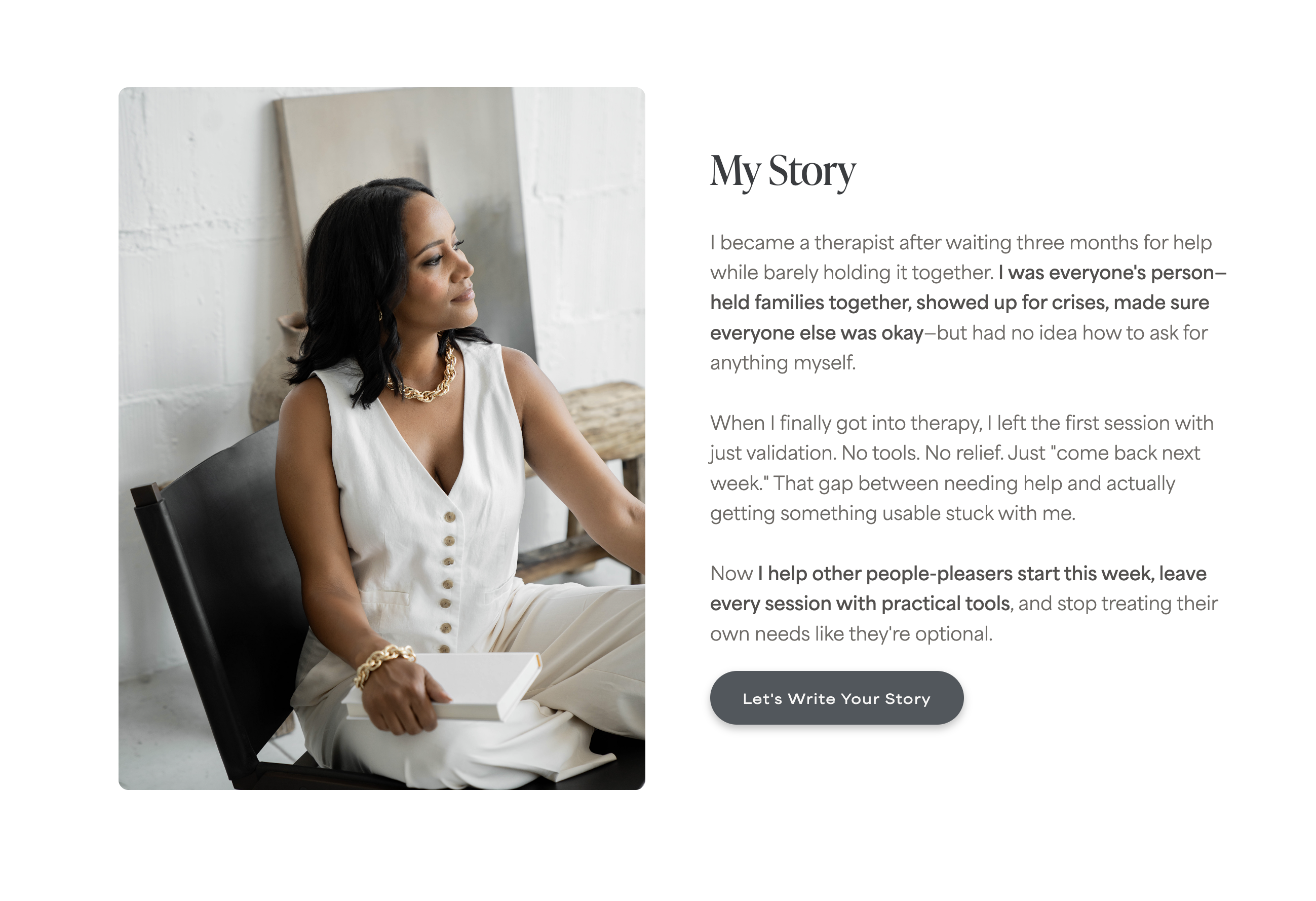
I became a therapist after waiting three months for help while barely holding it together. I was everyone's person—held families together, showed up for crises, made sure everyone else was okay—but had no idea how to ask for anything myself. When I finally got into therapy, I left the first session with just validation. No tools. No relief. Just "come back next week." That gap between needing help and actually getting something usable stuck with me. Now I help other people-pleasers start this week, leave every session with practical tools, and stop treating their own needs like they're optional.
Credentials:
I'm trained in modalities that focus on clarifying what matters to you and actually doing something about it.
- Licensed Clinical Social Worker (LCSW), North Carolina
- Master of Social Work, UC Berkeley
- Certified in Acceptance and Commitment Therapy (ACT)
- Training in Burnout Prevention and Recovery
Practice:
I see clients via secure video throughout New York and in-person in Manhattan.
(158 words)
Couples Therapy (EFT/Cycle Work) - Structure 3
My Background
I started doing couples work after watching too many smart, caring people hurt each other without meaning to. I kept seeing the same pattern: good intentions, painful outcomes, and both partners confused about how they kept ending up in the same fight. Training in Emotionally Focused Therapy showed me that most relationship problems aren't communication issues—they're safety issues. Now I help couples interrupt those patterns and build something more secure.
Credentials:
I'm trained in attachment-based approaches, not skills-based communication therapy.
- Licensed Marriage and Family Therapist (LMFT), California
- Master of Arts in Marriage and Family Therapy, Alliant International University
- Certified EFT Therapist (International Centre for Excellence in EFT)
- Training in Gottman Method Couples Therapy
Practice:
I work with couples in San Francisco (in-person) and throughout California (telehealth).
(132 words)
Sex Therapy (Shame-Free/Communication) - Structure 4
My Background
I built this practice because most people struggle to talk about sex honestly, even with a therapist. I kept seeing clients who wanted help with desire differences, pain, or performance anxiety but felt too ashamed to bring it up directly. Traditional sex therapy often felt clinical or awkward—reinforcing the same discomfort people were trying to overcome. I learned that shame-free space isn't just nice to have—it's foundational. Now I help couples and individuals address what's not working sexually in a space where nothing is off-limits.
Credentials:
I'm trained in approaches that center communication and reduce shame, not just techniques.
- Licensed Marriage and Family Therapist (LMFT), Oregon
- Master of Arts in Counseling Psychology, Lewis & Clark College
- Certified Sex Therapist (AASECT)
- Training in Sensate Focus and Gottman Method
Practice:
I see clients via secure video throughout Oregon and in-person in Portland.
(148 words)
Somatic Therapy (Body-First Trauma) - Structure 2 + Negative Space
My Background
I came to somatic therapy after years of talk therapy that helped me understand my anxiety but couldn't stop it. I could articulate exactly why I was anxious, but my body was still in fight-or-flight mode. I don't do therapy where insight is the only goal—when I learned to work WITH my body instead of just analyzing thoughts, everything shifted. Now I help clients access what their bodies already know, without spending years just talking about it.
Credentials:
I'm trained in modalities that work with your body's wisdom, not just cognitive reframes.
- Licensed Professional Counselor (LPC), Colorado
- Master of Arts in Clinical Mental Health Counseling, Naropa University
- Certified Somatic Experiencing Practitioner (SE)
- Training in Sensorimotor Psychotherapy
Practice:
I see clients in Boulder and via secure video throughout Colorado.
(143 words)
Why These Work
Each story uses ONE structure consistently. Individual therapy uses Structure 2 ("I was you" mirror with identity language). Couples uses Structure 3 (clinical observation, no personal disclosure needed). Sex therapy uses Structure 4 (contrarian positioning against clinical awkwardness). Somatic uses Structure 2 + negative space enhancement.
All stories use past tense for struggle ("I was," "I kept seeing," "I learned"), present tense for current work ("Now I help"). This signals resolved journey, builds confidence you've crossed the bridge they need to cross.
Stories are 80-120 words (3-4 sentences)—enough context to connect, brief enough to respect their time. Total sections are 125-175 words including credentials—can be read in under 45 seconds.
Credential bridges connect story to training explicitly. "I'm trained in attachment-based approaches, not skills-based communication therapy" reinforces the EFT focus stated in the story. Every bridge explains the common thread in training using positioning language.
Credentials list only 3-4 bullets that directly support stated approach. If story is about body-based work, training shows somatic certifications. If story is about tools/action, training shows ACT. No credential listed unless it proves the approach.
Each example includes 1-2 enhancement strategies (not all 3). Individual therapy has memorable insight ("that gap between needing help and actually getting something usable"). Somatic has negative space ("I don't do therapy where insight is the only goal"). Sex therapy frames outcome as capability ("address what's not working"). These enhance without overwhelming.
Stories explain WHY the therapist practices this specific way. Individual therapy story explains same-week starts (experienced 3-month wait) and tools focus (left session empty-handed). Couples story explains cycle work over communication skills (saw pattern of good intentions, painful outcomes). This angle integration builds trust.
3 Deadly Mistakes
❌ Mixing structures creates confusion
"I was the reliable one [Structure 2] who watched too many clients struggle [Structure 3] after my own difficult divorce [Structure 1] because traditional therapy asks people to relive trauma [Structure 4]."
✅ Pick ONE structure: Choose the structure that matches your positioning best. Add 1-2 enhancements max, but keep base structure consistent.
Mixing structures jumps between four different narratives. Readers lose the thread. Pick one clear arc and follow it through.
❌ Present tense struggle signals unresolved journey
"I am a recovering perfectionist working on boundaries."
✅ Use past tense for struggle, present for work: "I was a perfectionist who couldn't turn off self-criticism. Now I help others quiet that critical voice."
Present tense struggle ("I am working on") sounds ongoing, unresolved. Creates doubt about whether you can guide them if you're still figuring it out. Past tense signals completed journey.
❌ Credentials don't support stated approach
Story is all about body-based trauma work. Credentials list CBT, psychodynamic therapy, career counseling training.
✅ List only credentials that prove your approach: If story = body-based, credentials = somatic certifications. If story = tools focus, credentials = ACT/DBT. If story = EFT, credentials = attachment training.
Every credential bullet must reinforce your stated approach. Unrelated credentials create confusion about what you actually do.
Save your work: AboutPage_Story_V1
Next up: Working With Me Means. They know your background and credentials. Now they need to understand the practical experience of working with you—what sessions feel like, what you expect from them, what they can expect from you. That's what builds final confidence before the CTA.
0 Comments