
6. Differentiation Chart - Show Clear Contrast
About this section
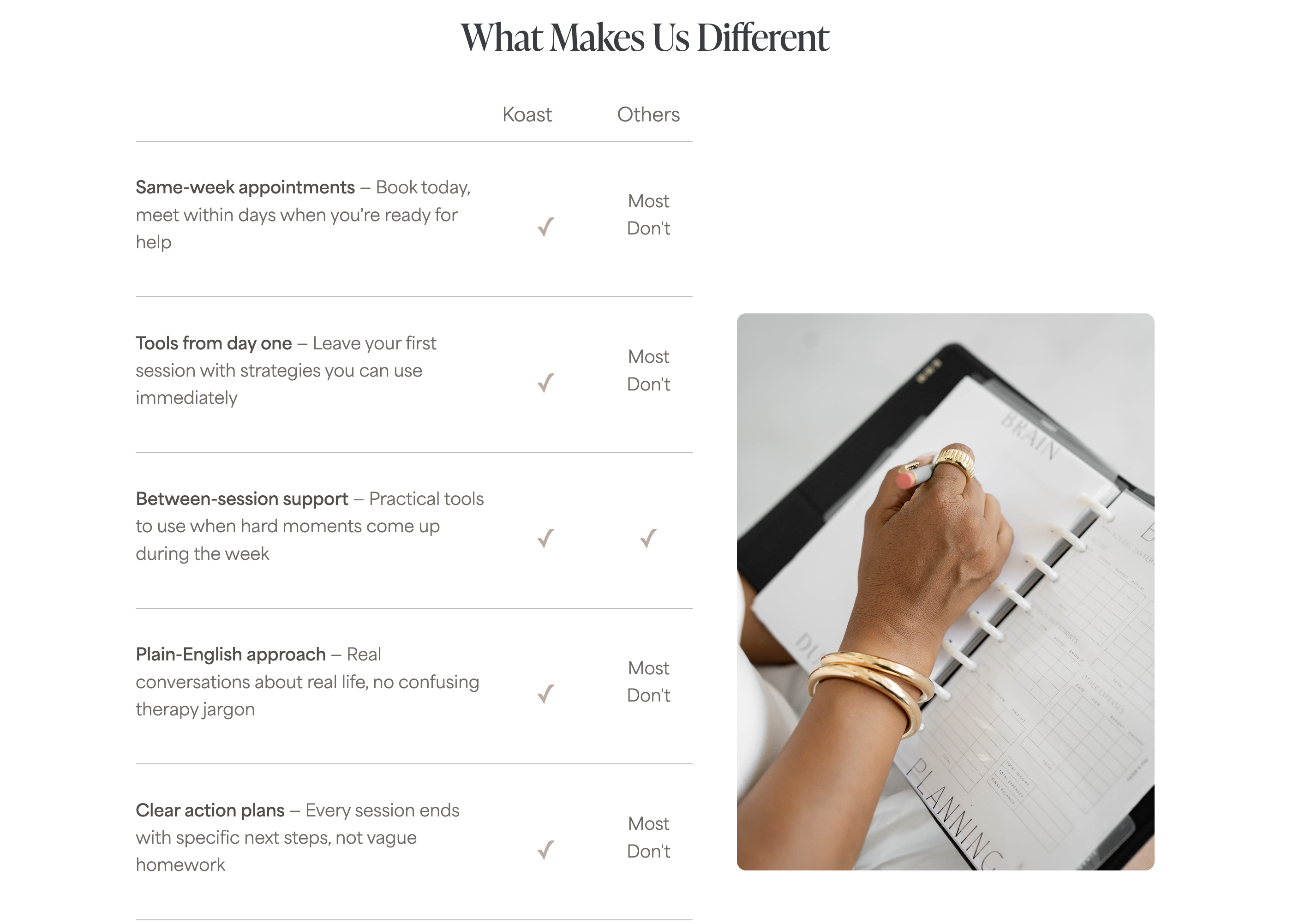
The conversion moment: They've seen your services and are still here. Now they're asking: "Okay, but what actually makes this therapist different from the 10 other tabs I have open?" This section answers that question with stark, specific contrast. Not "better"—just genuinely different in ways that matter.
The data: 78% of therapy website visitors struggle to differentiate between providers because "everyone sounds the same" (Psychology Today User Research, 2023). Aligned differentiators increase consultation bookings by 23-31% because prospects can finally see what makes you the right fit (Conversion Rate Experts, 2023).
Where this goes: After Service Snapshot, before Dual Pricing Card or Case Study.
What you're building: A two-column comparison table showing 6 specific differentiators. Left column: "You" (or your practice name). Right column: "Typical Therapy" (showing checkmarks or "Most Don't"). Format: two-column table with checkmarks, automatically formatted for mobile/tablet.
Critical principle: All 6 differentiators must point in the same direction—reinforcing your angle. Scattered benefits confuse. Aligned differentiators create memorable positioning.
DO THIS NOW: Write Your 6 Differentiators (15 Minutes)
Step 1: Pull your core angle (2 minutes)
What's the ONE thing you want prospects to remember about working with you? Pull this from your hero section or positioning work.
Write it down.
This is your north star. Every differentiator must support this.
Step 2: Choose your 6 differentiators using selection method (5 minutes)
Selection strategy:
Pick 2 core angle differentiators (what you're KNOWN for)
Pick 3 delivery differentiators (HOW you deliver on your angle)
Pick 1 trust/friction-remover (removes barrier or proves it works)
Ask 4 questions for each potential differentiator:
- Does this reinforce my core angle?
- Does this solve a frustration with typical therapy?
- Is this specific enough to picture?
- Can I consistently deliver this?
If yes to all 4 → it makes the list.
Competitor check: Look at 3-5 therapist websites in your area. What do they all say? ("compassionate," "evidence-based," "safe space") Don't use those—they're table stakes, not differentiators.
Write down your 6 differentiators.
Step 3: Write each differentiator using formula (6 minutes)
Formula:
Bold headline (2-5 words) — Specific descriptor solving problem/showing benefit (10-15 words)
Headline: What you do differently
Descriptor: Why it matters (pain point solved or benefit created)
Write each:
- Headline (2-5 words)
- Descriptor (10-15 words)
Right column decision:
For each differentiator, mark right column as:
- "Most Don't" if you're one of few who do this (rare differentiator)
- "Some Do" if others do it but you do it better
- Checkmark (✓) if common but important to state
Step 4: Choose section headline (2 minutes)
Options:
- "What Makes Us Different" (direct)
- "Why Choose [Your Practice Name]" (practice-specific)
- "Here vs. Typical Therapy" (contrast-focused)
- "What You Can Expect Here" (benefit-focused)
Recommendation: Use your practice name ("Why Choose [Name]") or generic "Here" if sole practitioner. Creates specificity.
Write your headline.
Complete Examples
Individual Therapy (Overwhelm/Tools Focus)
Why Choose Koast

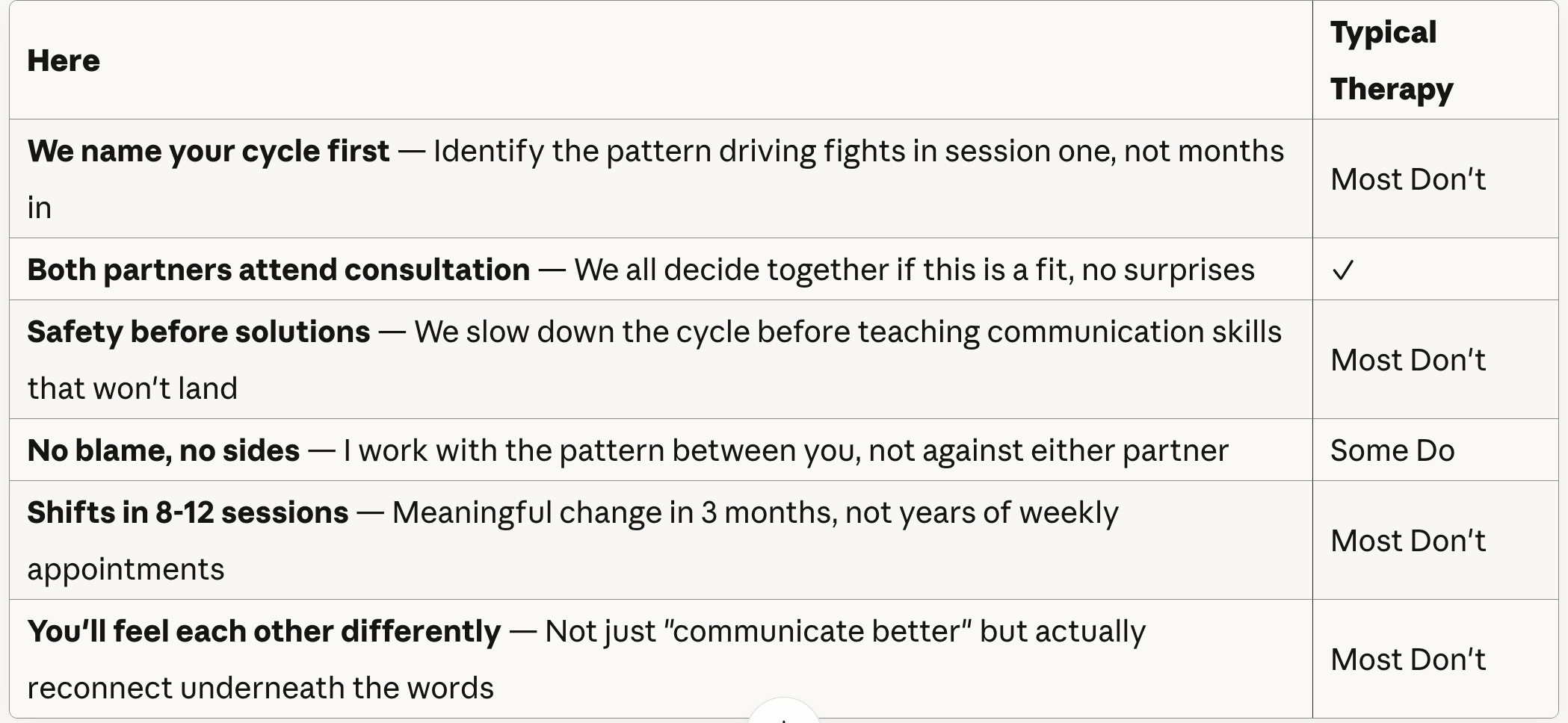
Couples Therapy (Attachment/EFT Focus)
What Makes Us Different
Sex Therapy (Shame-Free/Communication Focus)
Here vs. Typical Therapy

Somatic Therapy (Body-First Trauma)
Why Choose Us

Why These Work
Each example shows 6 differentiators aligned with one coherent angle. Individual therapy reinforces speed + tools (no waitlist, actual tools, text support, optional homework). Couples reinforces attachment/cycle work (name cycle, safety first, shifts fast, feel differently). Sex therapy removes shame (nothing shocks, zero awkwardness, relief first session). Somatic emphasizes body-first (no retelling, nervous system pace, physical shifts).
Right column strategy creates clear contrast. "Most Don't" for rare differentiators (no waitlist, text support, name cycle, no retelling trauma). "Some Do" for differentiators done by others but emphasized here (zero jargon, no blame, medical referrals). Checkmark for important table stakes (both partners attend, individual or couples welcome).
Descriptors solve specific pain points. Individual: "during your worst week" (urgency), "worksheets you'll ignore" (realistic), "2am panic" (exact moment). Couples: "not months in" (timing frustration), "won't land" (communication skills failure). Sex therapy: "not weird for bringing this up" (shame removal). Somatic: "chest tightness eases" (physical evidence).
Language creates memorable contrast. Not "fast appointments" but "no waitlist ever." Not "practical tools" but "actual tools you'll use—not worksheets you'll ignore." Not "body-based" but "your body already knows—we work with sensation, not story." Specificity sticks.
Word counts stay tight. Headlines: 2-5 words. Descriptors: 10-15 words. Total per line: 15-20 words. Scannable on mobile, complete enough to understand.
All reinforce hero angle. If hero promised same-week + tools, chart proves it (no waitlist, actual tools, text support). If hero promised attachment work, chart proves it (name cycle, safety first, feel differently). Consistency builds trust through repetition.
3 Deadly Mistakes
❌ Listing credentials instead of experience
Differentiator: "EMDR-certified — Completed 50+ hours advanced trauma training"
Why it fails: That's your resume, not their experience. Doesn't solve a frustration or show what working with you feels like.
✅ Fix: "No retelling trauma required — Your body already knows. We work with sensation, not story." Shows experience + solves fear.
❌ Scattered differentiators with no coherent angle
Chart shows: Same-week appointments, Sliding scale, EMDR-trained, Pet-friendly office, Weekend sessions, Mindfulness approach
Why it fails: Six random nice things. No coherent positioning. Visitor thinks "So... what are they actually about?"
✅ Fix: All 6 must support same angle. If angle = speed + tools, all 6 should reinforce fast access and immediate practicality.
❌ Using generic claims every therapist makes
Differentiators: "Compassionate care," "Safe space," "Evidence-based treatment," "Confidential sessions," "Professional service"
Why it fails: Table stakes, not differentiators. Every therapist offers these. Creates no contrast or memory.
✅ Fix: Focus on what makes YOU specifically different. Not what makes you qualified—what makes the experience of working with you distinct from others.
Save your work: Homepage_DifferentiationChart_V1
Next up: Dual Pricing Card. They understand what makes you different. Now they need to know if they can afford it—and which service fits their situation. That's what pricing transparency delivers.
0 Comments