
2. Mini Bio - Build Trust Through Your Story
About this section
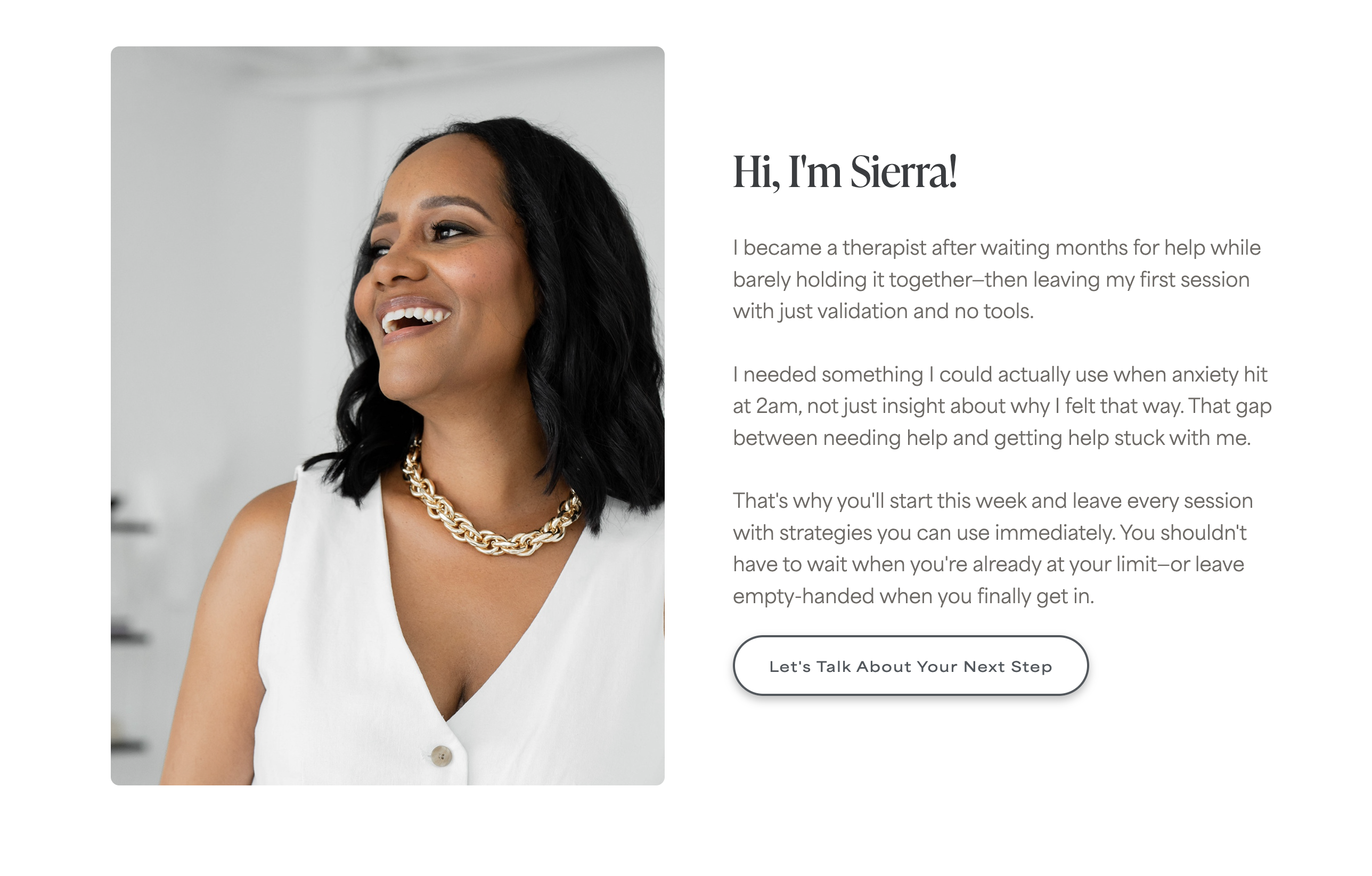
The conversion moment: They just read your hero and decided to stay. Now they're asking: "But who is this person? Do they actually understand what I'm going through? Or is this just marketing?" Your mini bio answers that question. This is the trust handshake that happens before they keep reading.
The data: Perceived therapist empathy is the strongest predictor of therapy outcomes—stronger than modality or years of experience (American Psychological Association, 2019). Your bio either builds or breaks that empathy connection.
Where this goes: Immediately after your hero section on the homepage.
What you're building: A 80-100 word story that validates WHY you practice with your specific angle. Not your credentials. Not your resume. A story that makes someone think "they actually get why this matters because they lived it."
Critical principle: Your story must explain your angle. When someone reads your bio and thinks "Oh, THAT'S why they do [your angle]. It's not just marketing—they believe it," trust skyrockets. When your story doesn't connect to your angle, people think "nice story, but why are you telling me this?" and bounce.
DO THIS NOW: Write Your Mini Bio (12 Minutes)
Step 1: Pull your angle and identify your "why" story (4 minutes)
Pull your angle. What makes you different? (From your hero section or positioning work.)
Examples: Same-week starts + tools day one, trauma-informed gentle pacing, body-first work, zero jargon, couples attachment focus.
Write it: _________________________________
Identify your "why" story. What personal experience taught you this angle matters?
Think about:
- Did you or someone close experience what doesn't work?
- Did you witness harm from traditional approaches?
- Did you have a breakthrough showing you a better way?
Write 2-3 sentences: _________________________________
Step 2: Write your bio using the formula (5 minutes)
The formula:
Hi, I'm [Your Name].
[Personal experience that taught you your angle matters—2-3 sentences with emotional truth and specific details]
That's why I [your angle]. [Client benefit in direct language].
What to include:
- Emotional truth: How it FELT (scared, exhausted, hopeless, embarrassed)
- Specific details: What you saw/heard/felt (2am anxiety, bathroom floor, waiting 7 weeks)
- Direct address: Talk TO them (you shouldn't have to, you deserve)
- Why you care: Not just what you do differently
Target length: 80-100 words
Write it now. Don't polish. First drafts are usually warmer.
Step 3: Test the connection and warmth (3 minutes)
Read your bio aloud and ask:
✅ Does my story EXPLAIN why I practice with my angle? (Not just "I'm relatable"—does it validate my positioning?)
✅ Does it feel WARM? (Would I say this to a friend? Or does it sound clinical/polished?)
✅ Would my ideal client think "they get why this matters"?
✅ Is it 80-100 words? (Count them.)
If yes to all four, you're done. If not, adjust the part that's off.
Make it warmer by:
- Using contractions (I'm, you're, don't)
- Talking TO them (you/your)
- Adding sensory details (time of day, physical space)
- Showing vulnerability (felt broken, embarrassed, desperate)
Complete Examples
Individual Therapy (Overwhelm/Tools Focus)
Hi, I'm Sierra.
I became a therapist after waiting months for help while barely holding it together—then leaving my first session with just validation and no tools. I needed something I could actually use when anxiety hit at 2am, not just insight about why I felt that way. That gap between needing help and getting help stuck with me.
That's why you'll start this week and leave every session with strategies you can use immediately. You shouldn't have to wait when you're already at your limit—or leave empty-handed when you finally get in.
(95 words)
Couples Therapy (Attachment/EFT Focus)
Hi, I'm Marcus.
I became a couples therapist after nearly losing my own relationship to cycles we couldn't break. We'd have the same fight in different forms, try harder to "communicate better," and still end up disconnected. It wasn't until we addressed the attachment wounds underneath the arguments that anything actually changed.
That's why we focus on what's driving your cycle, not just the surface conflicts. Better words don't help when you don't feel safe enough to hear them. We build safety first, then everything else becomes possible.
(96 words)
Sex Therapy (Shame-Free/Communication Focus)
Hi, I'm Alex.
I built this practice after years of feeling too ashamed to talk about sex with anyone—even my own therapists who changed the subject when I tried. I learned that silence around sex doesn't protect people, it isolates them. The shame of not being able to talk about what wasn't working was worse than the actual problem.
That's why nothing you say will shock me here, and we talk about sex like any other part of your life. You shouldn't have to perform comfort with topics that matter to you. We start where you are.
(99 words)
Somatic Therapy (Body-First Trauma)
Hi, I'm Jordan.
I did years of talk therapy that helped me understand my trauma intellectually—I could explain exactly why I felt the way I did. But my body didn't get the memo. I'd leave sessions with perfect insight and a racing heart, tight chest, and hands that wouldn't stop shaking. Understanding what happened wasn't enough to calm my nervous system.
That's why we work with what your body's holding, not just what your mind can explain. Sometimes your body needs the attention first—the words can come later.
(97 words)
Why These Work
Each bio connects personal experience directly to the angle. Sierra's story validates same-week starts + tools (waiting months, leaving empty-handed). Marcus's validates attachment work (communication didn't help, wounds underneath did). Alex's validates shame-free approach (silence isolated, not talking made it worse). Jordan's validates body-first work (understanding didn't calm nervous system).
Every bio includes emotional truth. Sierra: "barely holding it together." Marcus: "nearly losing my relationship." Alex: "too ashamed to talk." Jordan: "my body didn't get the memo." These phrases make the experience visceral.
All include specific details. Sierra: "2am anxiety." Marcus: "same fight in different forms." Alex: "therapists changed the subject." Jordan: "racing heart, tight chest, shaking hands." Specificity creates recognition.
Each speaks directly to the client. "You shouldn't have to wait" (Sierra). "We build safety first" (Marcus). "Nothing will shock me" (Alex). "Sometimes your body needs attention first" (Jordan). Direct address creates connection.
Word counts stay tight: 95-99 words. Long enough for emotional connection, short enough to maintain momentum before next section.
Structure follows formula: Hi, I'm [Name] → Personal experience (2-3 sentences) → That's why I [angle] → Client benefit. This creates clear throughline from story to positioning.
3 Deadly Mistakes
❌ Story doesn't connect to angle
Hero: "Therapy that starts this week. Tools from day one."
Bio: "I became a therapist after my own journey with burnout taught me the importance of boundaries and self-compassion..."
Why it fails: Prospect is confused. "Why are you telling me about boundaries when I came here for same-week starts?"
✅ Fix: Make sure your story directly explains why you practice with your specific angle. If your angle is speed + tools, story must be about waiting/leaving empty-handed.
❌ Too clinical, not warm
"I became a therapist after observing the negative impact of extended wait times on client outcomes and recognizing the need for more accessible mental health services."
Why it fails: Sounds like a research paper. No emotional connection. No humanity.
✅ Fix: "I watched someone I care about lose hope while waiting seven weeks for help. That's when I knew I'd never have a waitlist." Specific, vulnerable, human.
❌ Credential list instead of story
"I'm a Licensed Clinical Social Worker with 10 years of experience specializing in CBT, DBT, and EMDR for anxiety and depression."
Why it fails: Impressive but doesn't build empathy. Doesn't explain your approach. Could be anyone.
✅ Fix: Lead with story that validates your angle. Credentials live on your About page. Homepage bio creates connection through shared experience.
Save your work: Homepage_MiniBio_V1
What you just built: A story-driven bio that validates your positioning through personal experience, creates empathy through emotional truth, and maintains conversion momentum. Most therapists write generic bios. You created one that explains why YOU practice the way you do—with enough warmth that people feel the care behind it.
Next up: How It Works. They trust you now. Next question: "What actually happens if I work with you?" That's what this section delivers—a clear process that removes uncertainty and builds confidence.
0 Comments