
3. How It Works - Show The Clear Path Forward
About this section
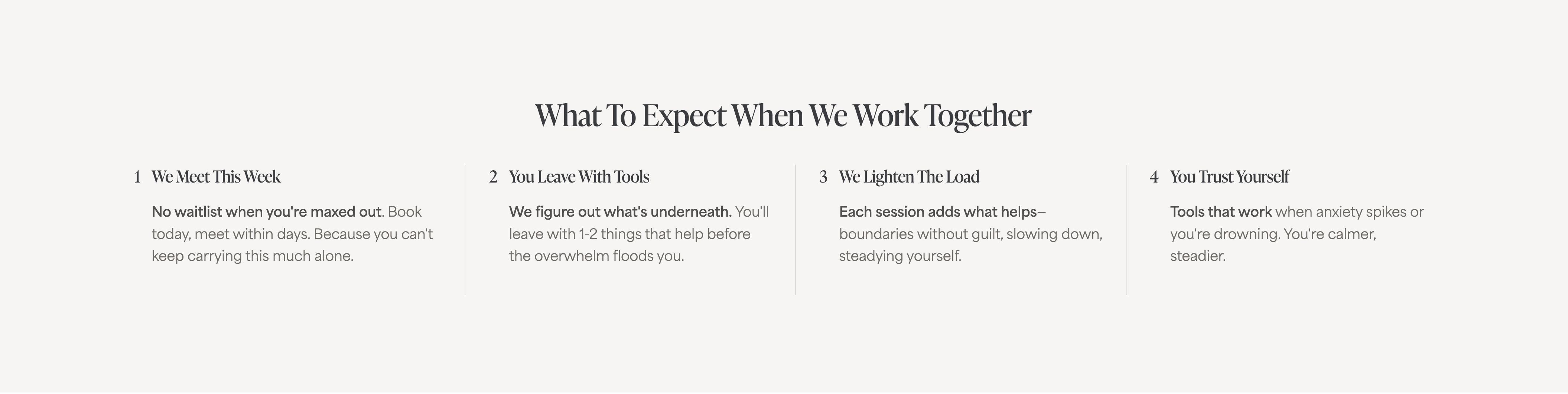
The conversion moment: They've read your hero and mini bio. They're interested. Now they're asking: "Okay, but what actually happens if I work with you? What's the process?" Uncertainty creates anxiety. This section removes it by showing a clear, predictable path from "I'm struggling" to "I'm steadier."
The data: Therapy websites that include clear process explanations see 41% higher consultation booking rates because they reduce "unknown anxiety" (Psychology Today Research, 2023). When people can picture the journey, they're more likely to start it.
Where this goes: After your mini bio, before featured service or differentiation sections.
What you're building: A 4-step process (15-20 words per step) that shows the journey from beginning to result while reinforcing your angle throughout. Format: numbered steps in visual boxes or cards, typically displayed vertically or left-to-right.
Critical principle: Your hero made a promise (your angle). Your mini bio explained why that matters. Your "How It Works" shows what it looks like step-by-step. If your process doesn't reinforce your angle, prospects get confused and bounce.
IMPORTANT: How This Differs From Other "How It Works" Sections
You'll create different "How It Works" sections for different pages. Don't copy this homepage version to other pages—each serves a different strategic purpose:
Homepage "How It Works" (this section):
- Purpose: General overview showing your unique process
- Focus: Reinforces your angle throughout all 4 steps
- Audience: First-time visitors comparing you to other therapists
- Length: 4 steps, 15-20 words each
- Strategy: Differentiation + reducing unknown anxiety
Individual Service Page "How It Works":
- Purpose: Specific process for individual therapy clients
- Focus: What happens in individual sessions specifically
- Audience: People who've decided on individual therapy, evaluating if YOUR process fits
- Strategy: Service-specific logistics + what makes your individual work different
Couples Service Page "How It Works":
- Purpose: Specific process for couples therapy clients
- Focus: What happens when both partners attend, cycle work, etc.
- Audience: Couples who've decided on couples therapy
- Strategy: Addresses couples-specific concerns (will we be blamed? do we both attend?)
Specialty Service Pages "How It Works":
- Purpose: Process for that specific specialty (sex therapy, EMDR, somatic, etc.)
- Focus: How that modality/specialty works in practice
- Audience: People researching that specific approach
- Strategy: Demystifies the specialty, removes method-specific fears
About Page:
- Doesn't typically have "How It Works"—that page is your story, credentials, philosophy
Key point: Homepage = general differentiated process. Service pages = service-specific details. Don't duplicate. Each page answers different questions at different stages of decision-making.
DO THIS NOW: Write Your 4-Step Process (15 Minutes)
Step 1: Pull your angle and choose your headline (3 minutes)
Pull your angle from your hero. What makes you different? Write it down.
Choose your section headline:
- "What to expect when we work together" (conversational, warm)
- "Here's what happens when you book" (direct, action-focused)
- "From first session to feeling steadier" (journey-focused)
- "How therapy works here" (simple, clear)
Pick the one that matches your voice and write it down.
Step 2: Write your 4 steps following the pattern (10 minutes)
The pattern (with emotional arc):
Step 1: THE BEGINNING (Where they start emotionally + how they start with you)
Step 2: FIRST SESSION (What happens + what they leave with)
Step 3: THE WORK (What accumulates week to week + what they're building)
Step 4: THE RESULT (Concrete outcome: how they feel + what they can do now)
Each step needs:
- Title (3-5 words, action or outcome-focused)
- Description (15-20 words explaining what happens from their perspective)
- At least 2 of 4 steps should explicitly reinforce your angle
Write each step. Keep descriptions 15-20 words. Make titles 3-5 words.
Step 3: Check continuity with your angle (2 minutes)
Continuity check:
- Pull your angle from Step 1
- Read each step description
- Ask: Does it mention my angle or show it in action?
At least 2 of 4 steps should explicitly show your angle. If not, rewrite to weave it in.
Optional add-on: Include timeline or social proof after Step 4:
- Timeline: "Most clients see shifts in 8-12 sessions"
- Social proof: "Join 200+ clients who've found steadier ground here"
Write it down if you're including this.
Complete Examples
Individual Therapy (Overwhelm/Tools Focus)
What To Expect When We Work Together
1. We meet this week
No waitlist when you're maxed out. Book today, meet within days. Because you can't keep carrying this much alone.
(16 words)
2. You leave with tools
We figure out what's underneath. You'll leave with 1-2 things that help before the overwhelm floods you again.
(18 words)
3. We lighten the load weekly
Each session adds what helps—boundaries without guilt, slowing down, steadying yourself. You're building capacity, not just understanding why you're exhausted.
(22 words)
4. You trust yourself again
Tools that work when anxiety spikes or you're drowning. You're calmer, steadier. You can care for others without abandoning yourself.
(21 words)
Couples Therapy (Attachment/EFT Focus)
Here's What Happens When You Book
1. We start within the week
Book your free consultation. Both partners attend. We talk about your cycle—the pattern driving your fights—not who's right or wrong.
(20 words)
2. We identify what's underneath
Your first full session names the cycle you're stuck in. You'll leave understanding what's really happening when you fight.
(19 words)
3. We build safety first
Week by week, we slow down the cycle and create moments where you feel each other differently. Safety comes before solutions.
(20 words)
4. You reconnect
The cycle loses its grip. You can repair when you disconnect. You feel seen by each other again, not just fighting to be heard.
(23 words)
Sex Therapy (Shame-Free/Communication Focus)
From First Session To Feeling Better
1. You schedule without shame
Book online or call. Individual or couples welcome. We'll meet this week—no awkwardness, just real conversation about what's not working.
(20 words)
2. We talk like it's any other topic
First session: we discuss what brings you in with zero judgment. You'll leave feeling heard, not weird for asking.
(19 words)
3. We build communication tools
Each session adds language and strategies that work in your actual relationship. You're learning to talk about sex like you talk about dinner plans.
(25 words)
4. Sex stops being a minefield
You can ask for what you want. Mismatched desire doesn't mean broken relationship. You have tools that actually work outside the bedroom too.
(23 words)
Somatic Therapy (Body-First Trauma)
The Path From Overwhelmed To Steadier
1. You book within the week
Schedule online or call. We'll meet this week or next—no long waits when your nervous system is maxed out.
(19 words)
2. We work with your body first
We start with what your body's holding, not just what your mind can explain. You'll leave with grounding tools you can use immediately.
(24 words)
3. You build somatic capacity
Week by week, we help your nervous system learn it's safe to relax. You're not just understanding—you're feeling the shifts.
(21 words)
4. Your body feels different
Panic doesn't hijack you the same way. Your chest doesn't tighten as fast. You have tools your body actually responds to.
(21 words)
Why These Work
Each example reinforces the therapist's specific angle throughout all 4 steps. Individual therapy emphasizes same-week access (Step 1) and tools (Steps 2-4). Couples therapy emphasizes cycle work (Steps 1-3) and safety before solutions (Step 3). Sex therapy removes shame (Steps 1-2) and normalizes sex talk (Steps 3-4). Somatic therapy prioritizes body-first work (Step 2) and nervous system capacity (Step 3).
Step structure follows emotional arc pattern. Step 1 addresses where they start emotionally (maxed out, stuck in cycle, ashamed, nervous system overwhelmed). Step 2 shows first shift (getting tools, understanding cycle, feeling heard, learning grounding). Step 3 describes what accumulates (building capacity, creating safety, adding communication tools, somatic capacity). Step 4 names concrete outcome (trust yourself, reconnect, sex stops being minefield, body feels different).
Word counts stay consistent. Individual: 16-22 words per step. Couples: 19-23 words. Sex therapy: 19-25 words. Somatic: 19-24 words. Target range 15-20 words creates consistency and scannability, though 21-25 is acceptable if detail requires it.
Descriptions use "their perspective" language. Not clinical ("comprehensive assessment") but experiential ("we figure out what's underneath"). Not therapist-focused ("I will conduct") but client-focused ("you'll leave with"). This creates recognition and reduces intimidation.
Titles are action or outcome-focused. "We meet this week" (action). "You leave with tools" (outcome). "We build safety first" (action). "Your body feels different" (outcome). 3-5 words each, scannable at a glance.
At least 2 steps per example explicitly mention the angle. Individual mentions "no waitlist" and "tools" directly. Couples mentions "cycle" three times. Sex therapy names "no awkwardness" and "zero judgment." Somatic states "work with your body first" explicitly.
3 Deadly Mistakes
❌ Steps break continuity with your angle
Hero promises "same-week starts + tools day one" but Step 2 says "We spend 6 weeks building rapport and exploring your history before beginning interventions."
Why it fails: Prospect is confused. "Wait, I thought I'd get tools immediately?" Message inconsistency destroys trust.
✅ Fix: Make sure at least 2 of 4 steps explicitly reinforce your angle. If angle = tools day one, Step 2 must mention leaving with tools.
❌ Unequal step lengths create visual imbalance
Step 1: 8 words. Step 2: 35 words. Step 3: 12 words. Step 4: 40 words.
Why it fails: Visually jarring. Looks unfinished. Readers assume shorter steps are less important or skim the long ones.
✅ Fix: Keep all steps 15-20 words (21-25 acceptable if detail needed). Consistent length = professional polish + easier to scan.
❌ Clinical language instead of client experience
"Step 1: Comprehensive biopsychosocial assessment and treatment planning conducted."
Why it fails: Intimidating, not reassuring. Sounds like medical procedure. Increases anxiety instead of reducing it.
✅ Fix: "We talk about what's happening and what you need most. You'll leave with clarity and a plan." Client perspective, human language.
Save your work: Homepage_HowItWorks_V1
What you just built: A clear 4-step process that reduces "unknown anxiety" by showing the predictable journey from struggling to steadier. Each step reinforces your angle. Word counts stay consistent (15-20 words per step). Emotional arc guides prospects from where they start to where they'll end up. Visual format (numbered steps in boxes/cards) makes it scannable. Optional timeline or social proof can follow Step 4. Most therapists skip this section or make it clinical. You created a roadmap that builds confidence and maintains conversion momentum.
Remember: This homepage version is different from your service page processes. Don't copy this to individual, couples, or specialty pages—those need service-specific details. Homepage = general differentiated overview. Service pages = specific logistics for that service type.
Next up: Featured Service. They understand the process. Now they need to know which service fits their situation—individual, couples, or specialty work. That's what the featured service section delivers.
0 Comments